Questões de Concurso
Filtrar
135 Questões de concurso encontradas
Página 4 de 27
Questões por página:
“The team delivered the report on time; ___________, several important details were missing.”
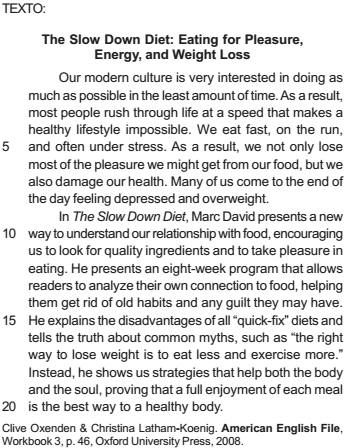
In this sentence, the words in bold, not only…but also, express
Instrução: Leia o artigo 11 da Declaração Universal dos Direitos Humanos, em inglês, para responder a questão, assinalando a alternativa que completa corretamente as respectivas lacunas.
The Universal Declaration of Human Rights
Article 11
(1) Everyone charged with a penal offence has the right to be presumed innocent —— 71 proved guilty according to law in a public trial at which he —— 72 all the guarantees necessary for his defence.
(2) No one shall be held guilty of any penal offence on account of any act or omission — 73 — did not constitute a penal offence, under national or international law, at the time when it was committed. Nor shall a heavier penalty be imposed than the one that was applicable at the time the penal offence was committed.
(www.un.org. Adaptado.)
Assim, analise as afirmativas a seguir:
I.Advérbios de frequência (como *always*, *usually*, *often*) são geralmente posicionados *antes* do verbo principal (e.g., "She *always arrives* late").
II.Quando a frase utiliza o verbo *to be* como verbo principal, o advérbio de frequência é posicionado *depois* dele (e.g., "She *is always* late").
III.Advérbios de modo (como *slowly*, *quietly*), que descrevem *como* a ação é feita, são tipicamente colocados após o verbo principal ou após o objeto direto, se houver (e.g., "He drives *carefully*" ou "He drives the car *carefully*").
Está correto o que se afirma em:
